You've probably never been inside a CO2 gas chamber. You've never had burning acid dissolve into your eyes, your nostrils, your throat, your lungs all at once. You've never screamed while your body tried to find air that didn't exist. You've never had your suffering dismissed as the acceptable cost of someone else's dinner.
She has. Right now, while you read this, she has.
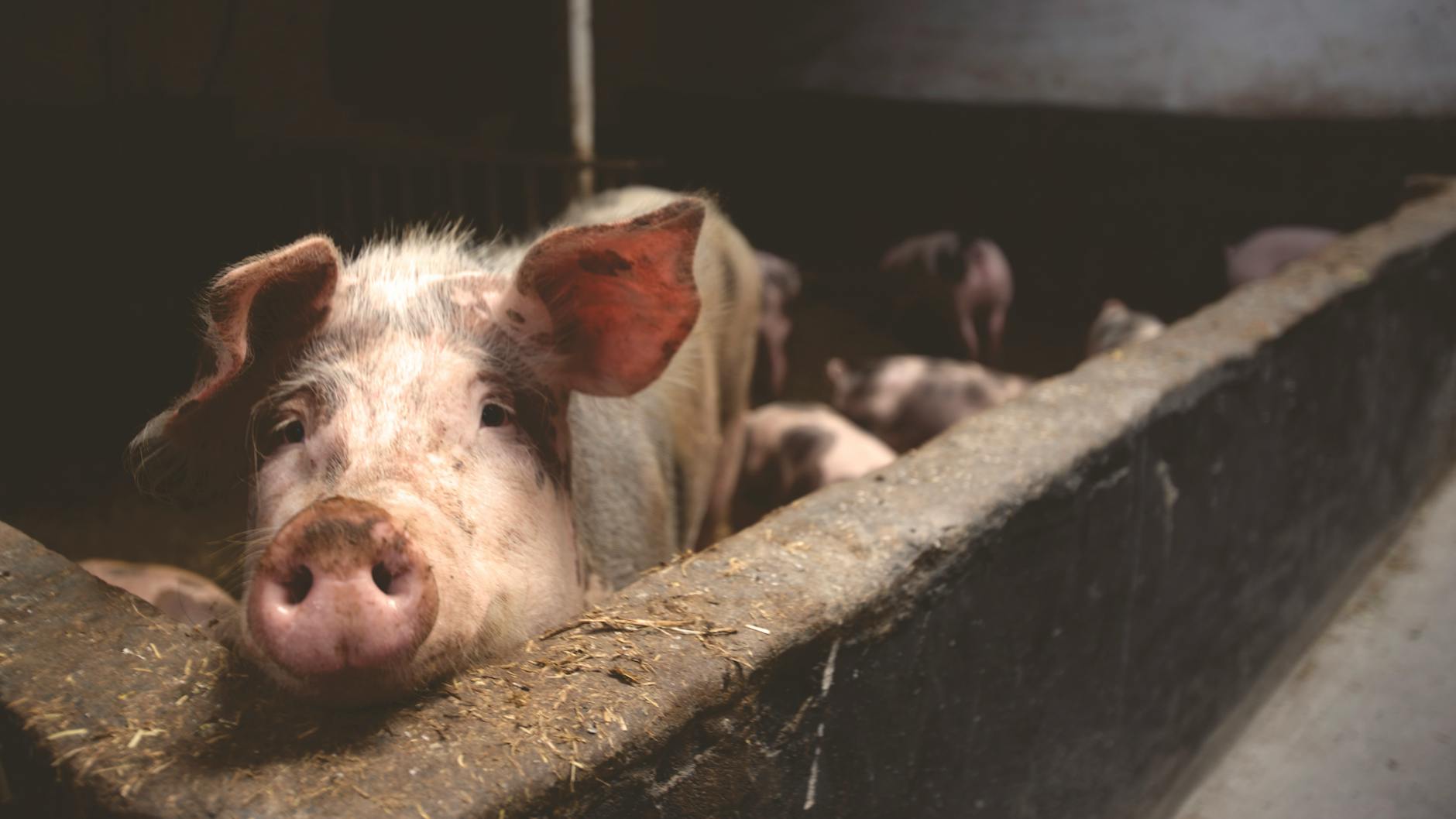
Photo by Matthias Zomer via Pexels
She's lowered into a metal chamber with five other pigs. The gas hits — carbon dioxide, high concentration — and the torture begins. It burns. It burns everything. The CO2 dissolves into every wet surface in her body and turns to acid. She's conscious for somewhere between 15 and 60 seconds while this happens — sufficiently aware to scream, to thrash, to shove her nose through the bars looking for air that isn't on fire. The UK government's own welfare committee calls this "avoidable pain, distress or suffering." They recommended banning it.
It hasn't been banned. Ninety percent of pigs slaughtered in the US and UK die this horrifying death. That's around 120 million animals a year, just in America. And the only reason it continues is that the people paying for it have decided a taste preference is worth more than her suffering.
If I barf, you'll let me live?
No. Nobody lets her live.
You Cried About a Dog Last Week
I know you did. Or you shared a video of a puppy rescue. Or you signed a petition against a puppy mill. Or you told someone you "love animals" while eating a sandwich that required one to die.
I'm not saying this to be cruel. I'm saying it because I used to be you. I had a dog I loved more than most humans. I fed him grain-free organic food because I cared about his health. And then I'd sit down to a dinner that came from an animal who was smarter than my dog.
That's not an insult. It's a peer-reviewed fact. Marino and Colvin (2015) compiled decades of research on pig cognition and found they outperform dogs on cognitive tests. They solve puzzles. They play games. They recognize themselves in mirrors — something most animals can't do and human children don't manage until 18 months. They form complex social bonds and mourn loss.
Your dog is wonderful. The pig on your plate was just as wonderful. The only difference is which one you decided to name.
"It Just Tastes Good" Is Not an Ethical Argument
Let me tell you about the 4Ns. Researchers Piazza, Ruby, Loughnan and colleagues published a study in Appetite in 2015 that might be the most damning piece of research ever conducted on why people eat meat. They asked thousands of participants to justify their meat consumption — spontaneously, without prompting — and found that 83–91% of all justifications fell into four categories: Natural, Normal, Necessary, and "Nice."
Nice. That's the column where taste lives. That's the best most people can do when asked to explain why an animal's life is worth less than a flavour.
The same study found that people who endorse "nice" as their justification score higher on measures of animal objectification and moral disengagement — they're also the people least willing to consider the animal's experience at all. The taste justification doesn't just rationalize the behaviour. It actively shuts down moral reasoning. Endorsing "it tastes good" as a reason to eat meat correlates with treating animals as objects, not beings. You tell yourself it's a preference. The research says it's a psychological defence.
Psychologist Hank Rothgerber calls it "motivated denial." His 2020 framework in Appetite shows people structure their food experiences specifically to prevent the dissonance from ever forming. You don't order "slaughtered pig" at a restaurant. You order a "pork chop." The language does the emotional work before the food reaches the table. By the time taste enters the picture, the psychological machinery has already been running for hours.
Saying "I eat it because it tastes good" isn't describing a neutral preference. It's activating a centuries-old cultural defence system designed to insulate you from thinking about what you're eating. It's outrageous when you see it clearly. A being capable of suffering is being tortured and killed, and the justification that survives every challenge is: nice.
The Barf Response Is Learned — and It Goes Both Ways
Here's what people actually mean when they say they'd have to barf to stop eating meat: they mean the food itself would need to cause physical disgust before they could give it up. The implication is that this response is fixed. Biological. An immovable wall between where they are and where they'd need to be.
It isn't.
A 2022 peer-reviewed study published in Frontiers in Nutrition tested this directly. Researchers followed participants through a one-month vegan challenge and measured meat disgust before, during, and after. The result flips the entire argument: reducing meat intake predicted subsequent increases in meat disgust. The less people ate, the stronger their aversion grew — correlation r = −0.44, p = 0.005. That's not marginal. That's a meaningful, replicable finding.
The barf response you're waiting for? It's already forming. You just keep eating meat fast enough to suppress it.
I went vegan in my mid-forties. First three weeks, I missed bacon. I'm not going to pretend otherwise. By month two, the smell of a breakfast buffet made me feel something I couldn't name at first — not quite nausea, but adjacent to it. By month three I walked past a butcher counter and had to actively not look. Nobody warned me the disgust was portable. Nobody told me you just had to pick it up and move it.
Taste preferences aren't permanent biological facts. They're trained responses. You've been training yours in one direction your whole life, and you've mistaken the training for nature.
The Comforting Lies
"But farm animals were bred for food." So? Being bred for a purpose doesn't erase the capacity to suffer. Dogs were bred to be companions — does that mean a dog born into a breeder's kennel who decides to eat it isn't suffering? Breeding doesn't create consent. It creates supply.
"I only buy humane meat." Do you? Ninety-nine percent of US meat comes from factory farms, according to the ASPCA. That "free-range" label means the barn door was technically open — not that anyone walked through it. And even the 1% that's genuinely "humane" ends at the same brutal place: a bolt gun to the head or a gas chamber. There is no humane way to kill someone who doesn't want to die. The "humane" label is a scam — a devastating piece of marketing designed to let you feel good about something you'd find horrifying if you witnessed it.
"I need the protein." The Academy of Nutrition and Dietetics — the world's largest organisation of nutrition professionals — states that well-planned vegan diets are appropriate for all stages of life. All of them. Including athletes, pregnant women, and children. This isn't a fringe position. This is institutional consensus.
The Scale Nobody Wants to Do the Math On
According to UN FAO data, 83 billion land animals were slaughtered globally in 2022. By 2023 that number was 85.4 billion — roughly 10.5 animals killed per human being on earth, every single year. The rate of killing is growing faster than the human population.
Work it out. That's approximately 2,700 land animal deaths every second. While you read this sentence, another 2,700 animals were killed. While you read this paragraph, tens of thousands more.
All of them going through CO2 chambers, bolt guns, throat cuts, or scalding water while still alive — which happens at a documented, horrifying rate the industry doesn't publicise. All of them because of a taste preference that peer-reviewed research shows isn't even permanent. All of that death, all of that suffering, all of that blood — for a flavour you'll get over within months of stopping.
In a 2024 survey of 30,216 consumers across 31 countries, 68% of people said they wanted to eat more plant-based foods. Only 20% actually did so consistently. The gap between those numbers — 48 percentage points — is measured in 85 billion lives per year. The pig in that gas chamber isn't dying because people can't imagine life without meat. She's dying because people haven't decided it matters enough to find out what happens when they try.
The Test You Already Know You'd Fail
Could you kill the animal yourself?
Not hypothetically. Actually. Could you walk into a room with a pig — an animal that would nuzzle your hand if you let it, that would play with a ball, that would look at you with eyes that know what fear is — and slit its throat? Could you hang a cow upside down by its ankle and cut its carotid artery while it's still blinking?
If you can't, you've already answered the moral question. You just haven't accepted the answer yet.
Outsourcing the violence doesn't make it disappear. It means someone else does the thing you know is wrong — and you pay them for it. Usually minimum wage, by the way, in conditions so psychologically brutal that slaughterhouse workers develop PTSD at rates higher than combat veterans. Your distaste for witnessing the killing doesn't make the killing ethical. It makes it invisible. Those are different things.
If You Love Animals, Your Plate Has to Say So
I'm not asking for perfection. I'm asking for consistency.
If you love animals — actually love them, not just the ones that make good Instagram content — then your plate has to reflect that. Not next year. Not when lab-grown meat hits supermarket prices. Now. Because right now, while you read this, a pig is being lowered into a gas chamber. She is screaming. She is burning. And she is at least as intelligent, at least as emotionally complex, and at least as capable of suffering as the dog sleeping somewhere near where you're sitting.
You don't need to barf to stop. You just need to decide that a flavour you'll adapt past within six weeks is worth less than a life you can't give back.
Watch Dominion. It's free. Watch it tonight. And then tell me — honestly — whether the answer to "if I barf, will you let me live?" is still no.
References
- UK Government Animal Welfare Committee (2024) — Opinion on CO2 Gas Stunning of Pigs
- Marino & Colvin (2015) — Thinking Pigs: Cognition, Emotion, and Personality in Sus domesticus
- Piazza et al. (2015) — Rationalizing Meat Consumption: The 4Ns — Appetite
- Rothgerber (2020) — Meat-Related Cognitive Dissonance: A Conceptual Framework — Appetite
- Becker et al. (2022) — Meat Disgust and Meat Avoidance — Frontiers in Nutrition
- Our World in Data / FAO (2024) — 83 Billion Land Animals Slaughtered Per Year
- Faunalytics / EAT-GlobeScan (2024) — Why Aren't Plant-Based Diets More Widespread?
- ASPCA — Animals on Factory Farms
- Academy of Nutrition and Dietetics (2016) — Position on Vegetarian Diets
- Dominion (2018) — Free documentary at dominionmovement.com