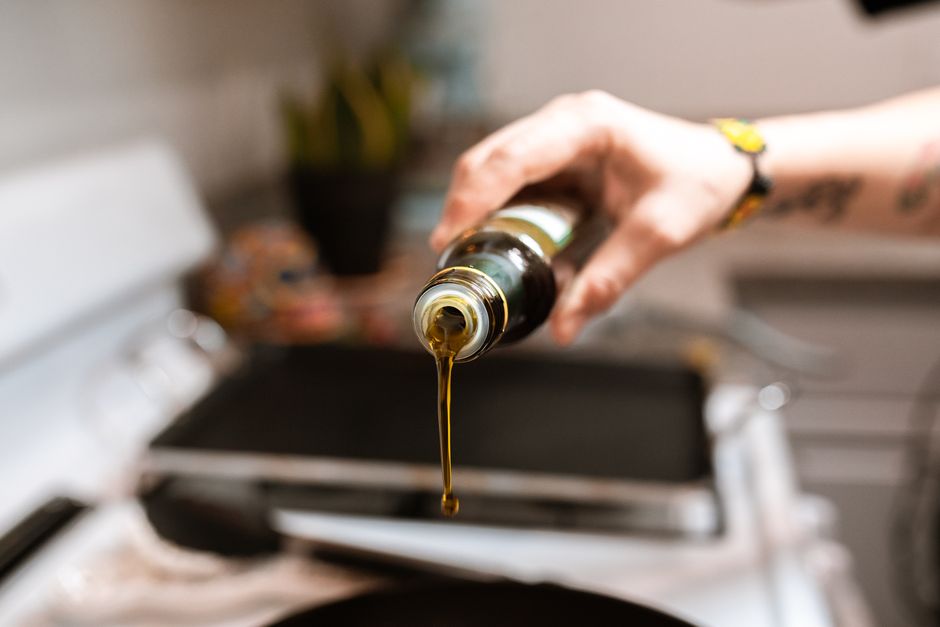
Photo by RDNE Stock project via Pexels
Have you ever wondered why someone selling $30 jars of beef tallow needs you to believe that a $4 bottle of canola oil is poison?
That's the question I kept coming back to while tracing the seed oil panic. Because the science on cooking fats is not actually that complicated. We have decades of randomized controlled trials. We have Cochrane reviews with 56,000 participants. We have AHA presidential advisories and government mortality data going back to 1900. None of it says seed oils are killing you. All of it says beef tallow — at roughly 50% saturated fat — is the one you should be limiting.
And yet here we are. In 2026, seed oils have become the dietary villain of the carnivore internet, amplified by podcasters, pushed by RFK Jr. during a presidential campaign, and used to sell premium jars of rendered animal fat at a markup that would make any supplement company jealous.
Let's go through this properly. Because the people pushing it are counting on you not to.
Where Did the Seed Oil Panic Come From?
Not a lab. Not a hospital. A podcast.
The modern seed oil panic traces directly to Paul Saladino's 2020 appearance on Joe Rogan's show. Saladino — an MD who advocates for an all-animal-products diet — popularized the claim that linoleic acid, the main omega-6 in vegetable oils like sunflower, canola, and soybean oil, was driving chronic inflammation, obesity, and modern disease. Before that episode, "seed oil" wasn't a widespread dietary villain. After it, the phrase spread through every corner of carnivore and wellness social media.
Cate Shanahan, who bills herself as "Mother of the No Seed Oil Movement," coined "the hateful eight" to describe eight vegetable oils she calls toxic. Tucker Goodrich — a finance professional with no nutrition credentials — spent years developing an elaborate theory about linoleic acid and mitochondrial dysfunction in internet forums and blog posts. None of this began in a peer-reviewed journal. All of it began in podcast monologues and contrarian corners of the internet, then got laundered into mainstream discourse through political channels.
RFK Jr. blamed seed oils explicitly for diabetes, obesity, heart disease, depression, and autism during his 2024 US presidential campaign. JD Vance agreed. McDonald's publicly tested beef tallow for fries. And Coast Packing Company — one of the largest animal fat shortening suppliers in the Western United States — formed the "Healthy Fats Coalition" with backing from the Weston A. Price Foundation and brands selling rendered animal fat at a premium price point.
You should ask yourself: is this what a grassroots public health discovery looks like? Or is this what a supply chain looks like when it finds a marketing strategy?
What Is Actually In Beef Tallow
Let's look at what's in these fats, because the tallow advocates rarely lead with the actual numbers.
Beef tallow is roughly 50% saturated fat per 100 grams. The breakdown: about 25g palmitic acid, 19g stearic acid, 5g myristic acid. Monounsaturated fat accounts for about 42%. Polyunsaturated fat — the kind in seed oils — is approximately 4%.
For comparison: canola oil is about 7% saturated fat. Sunflower oil around 10%. Olive oil roughly 14%. The "ancestral health food" being sold as a seed oil alternative contains five to seven times more saturated fat than the oils being called poison.
The tallow advocates have an answer for this: stearic acid, one of the saturated fats in tallow, behaves differently than other saturated fats and doesn't raise LDL cholesterol the way palmitic acid does. That's partially true. Stearic acid is somewhat metabolically neutral on LDL. But stearic acid is only one component of the saturated fat in tallow. The palmitic acid, which makes up about half of tallow's saturated fat, still raises LDL exactly as expected. The Physicians Committee for Responsible Medicine's March 2025 consumer alert is specific: beef tallow raises LDL cholesterol similarly to other animal fats, and in a study of 310,602 participants, substituting just 5% of calories from animal saturated fat with linoleic acid — the supposed "poison" — was associated with a 9% lower heart disease risk and 13% lower cardiovascular mortality.
That's not a rounding error. That's the kind of number that rewrites clinical practice.
Your Great-Grandmother Cooked With Lard and Died at 62. Was That Ancestral Health?
One of the most rhetorically powerful claims in the seed oil panic is the historical argument: people were healthier before seed oils became ubiquitous. Corn oil was invented in 1898. Crisco hit the market in 1911. Before that, everyone cooked with lard, butter, and beef tallow. So if seed oils are the culprit, reversing course should restore ancestral health.
The mortality record destroys this claim completely.
According to CDC data tracking mortality from 1900 to 1999, heart disease wasn't common in 1900 — not because people were thriving on animal fat, but because infectious disease killed them first. Life expectancy in 1900 was 47 years. Tuberculosis, pneumonia, and diarrheal diseases were the leading killers. Penicillin wasn't discovered until 1928. People weren't living long enough to die of heart disease at scale. That's not health. That's dying young of something else.
And here's the part that should genuinely end the argument: coronary heart disease peaked in the mid-1960s, according to a 2014 paper in the American Journal of Medicine tracking the 20th century CVD epidemic. The CVD mortality peak hit around 1963 — when lard, butter, and beef tallow still dominated kitchens across the US and Europe, and seed oils were barely in widespread use. The epidemic was driven by smoking, dietary cholesterol, and industrialized processed food broadly. CVD started declining as smoking rates fell and dietary patterns diversified.
If seed oils caused the modern health crisis, the crisis would have started later and tracked the adoption of seed oils. It didn't. CVD was rising fastest when animal fats dominated. The timeline is backwards.
I spent weeks going through this data. The "ancestral fat equals healthier era" argument only works if you ignore that people died young of infectious disease, that CVD peaked during the animal fat era, and that improvements in longevity were driven by antibiotics and reduced smoking rather than cooking fat choices. It requires a selective reading of history so aggressive it becomes dishonest.
What 56,675 People in Randomized Trials Found
Historical comparisons aren't conclusive. Fair enough. Let's look at the controlled studies.
The most comprehensive meta-analysis on saturated fat and cardiovascular disease is the Cochrane review published in 2020 — Hooper et al., covering 15 randomized controlled trials with 56,675 participants. Reducing saturated fat produced a 17% reduction in combined cardiovascular events. The critical nuance — and this is where the debate gets technically interesting — is that what you replace saturated fat with matters enormously. Replace it with refined carbohydrates and you see little benefit. Replace it with polyunsaturated fats — specifically the linoleic acid found in seed oils — and you get a cardiovascular benefit roughly comparable to statin therapy.
The 2017 AHA Presidential Advisory in Circulation — authored by some of the most credentialed nutrition researchers alive — summarized RCT evidence showing that replacing saturated fat with PUFA-rich vegetable oils reduced CVD by approximately 30%. The 2026 AHA Scientific Statement affirmed this guidance, explicitly recommending unsaturated fats in place of saturated fat as a core feature of heart-healthy eating.
There is a contrarian meta-analysis that tallow advocates cite: a 2025 study in JMA Journal (Yamada et al.) analyzing 9 RCTs with 13,532 participants that found no statistically significant reduction in cardiovascular mortality from saturated fat restriction. Is this evidence that the question is open? No. The analysis covered less than a quarter of the participants in the Cochrane review, and the authors acknowledged most included trials predate modern statin therapy, which significantly changes the cardiovascular risk environment. When you have 15 trials and 56,000 people on one side and 9 trials and 13,000 on the other, and the larger evidence base consistently shows benefit, that is not an open question in nutrition science. That is a settled debate with some noise around the edges.
The Linoleic Acid Oxidation Theory: Does It Actually Hold Up?
The most technically sophisticated argument in the seed oil panic is the oxidation theory. Linoleic acid, the main omega-6 in seed oils, is chemically unstable. It oxidizes when heated. When it oxidizes, it produces aldehydes and lipid peroxides. Those compounds are inflammatory and damage mitochondria. Therefore: seed oils are killing you slowly through oxidative damage.
This sounds plausible. Polyunsaturated fats do oxidize more readily than saturated fats at a molecular level. So does the evidence support it as a real dietary concern?
At normal cooking temperatures and dietary intakes: no. Johns Hopkins Bloomberg School of Public Health researchers reviewing the full evidence base in 2025 concluded: "There is abundant evidence suggesting that seed oils are not bad for you. If anything, they are good for you." Linoleic acid in the research literature is associated with lower risk of cardiovascular disease, heart attack, stroke, and type 2 diabetes. That's the opposite of what the oxidation theory predicts.
The oxidation concern is real in one specific context: industrial deep frying where the same oil is reused at extreme temperatures for days at a time. But this applies to all fats. Beef tallow also forms aldehydes when repeatedly heated at very high temperatures. If you're concerned about oxidative cooking byproducts, the answer is: don't reuse frying oil. That's a kitchen hygiene argument, not a case against seed oils specifically at normal household use.
Who Benefits If You Switch Back to Beef Tallow?
Seed oils are not made from animals. Beef tallow is rendered cattle fat. When households cook with vegetable oil instead of animal fat, the beef processing industry loses a revenue stream it held for decades.
The shift away from animal fats happened through the mid-20th century — partly because of early cardiovascular research, partly because industrial seed oil production was cheaper and more scalable. Every major food manufacturer made the switch. Reversing that is worth billions: every slaughtered cow produces rendered fat, and if that fat sells as a $25–$30 premium "ancestral" cooking product instead of industrial lubricant or cheap animal feed, the margin on every carcass improves significantly.
The "Healthy Fats Coalition" backing the beef tallow revival isn't a public health organization. It's an industry coalition led by Coast Packing Company — one of the largest animal fat suppliers in the US — and supported by brands selling premium tallow at markup prices. MIT Technology Review reported in January 2026 that recent US dietary guidelines faced significant industry pressure specifically around beef tallow recommendations.
I've written about the meat industry's long history of buying nutritional guidance and lobbying dietary policy. The tallow revival is the same playbook adapted for the social media era: skip the academic funding and go straight to podcast influencers and sympathetic politicians. The amplification mechanism is different from the 1980s lobbying era. The beneficiaries aren't.
If you've been following the carnivore diet movement closely, the seed oil panic is the companion piece. Same key figures, same funding interests, different specific claim. And when the American Heart Association published their 2026 Scientific Statement explicitly recommending against saturated fat, they weren't taking money from Big Canola. Their advisory directly contradicts what the ancestral health crowd is selling.
What You Should Actually Cook With
Extra virgin olive oil: about 14% saturated fat, rich in oleic acid, one of the most extensively studied foods in the world. Extensive evidence of cardiovascular benefit. The Mediterranean diet research base behind it is enormous and consistent. Use it.
Avocado oil: about 12% saturated fat, high smoke point, mostly oleic acid. Good for high-heat cooking.
Canola oil, sunflower oil, soybean oil: 7–12% saturated fat. Lower in saturated fat than any animal fat. The clinical evidence on linoleic acid at normal dietary intakes consistently shows cardiovascular benefit.
Beef tallow: roughly 50% saturated fat. The AHA says limit it. The Cochrane review of 56,000 people says replacing it reduces cardiovascular events. Fifty years of controlled trial evidence agrees.
One podcast says something different. You need to decide who you trust: the accumulated result of 56,000 people in randomized trials, or someone selling $30 jars of rendered animal fat. Share this with whoever told you canola oil was secretly destroying your health. Ask them where they read it. Time to stop letting carnivore influencers write your dietary guidelines.
If you want to understand the full picture of how the meat industry shapes what you think you know about food, start here: your doctor probably wasn't taught this either, and that's by design.
References
- Sacks FM et al. "Dietary Fats and Cardiovascular Disease: A Presidential Advisory From the American Heart Association." Circulation. 2017;136(3):e1–e23.
- Lichtenstein AH et al. "2026 Dietary Guidance to Improve Cardiovascular Health: A Scientific Statement From the American Heart Association." Circulation. 2026.
- Hooper L et al. "Reduction in saturated fat intake for cardiovascular disease." Cochrane Database of Systematic Reviews. 2020;8:CD011737.
- Dalen JE et al. "The Epidemic of the 20th Century: Coronary Heart Disease." American Journal of Medicine. 2014;127(9):807–812.
- CDC MMWR. "Achievements in Public Health, 1900–1999: Decline in Deaths from Heart Disease and Stroke." 1999;48(30):649–656.
- Physicians Committee for Responsible Medicine. "Beef Tallow: Doctors Group Shares Consumer Health Alert Warning." March 2025.
- Johns Hopkins Bloomberg School of Public Health. "The Evidence Behind Seed Oils' Health Effects." 2025.
- MIT Technology Review. "America's New Dietary Guidelines Ignore Decades of Scientific Research." January 2026.
- Wikipedia. "Seed oil misinformation." (Origin and spread of the panic — key figures and timeline.)