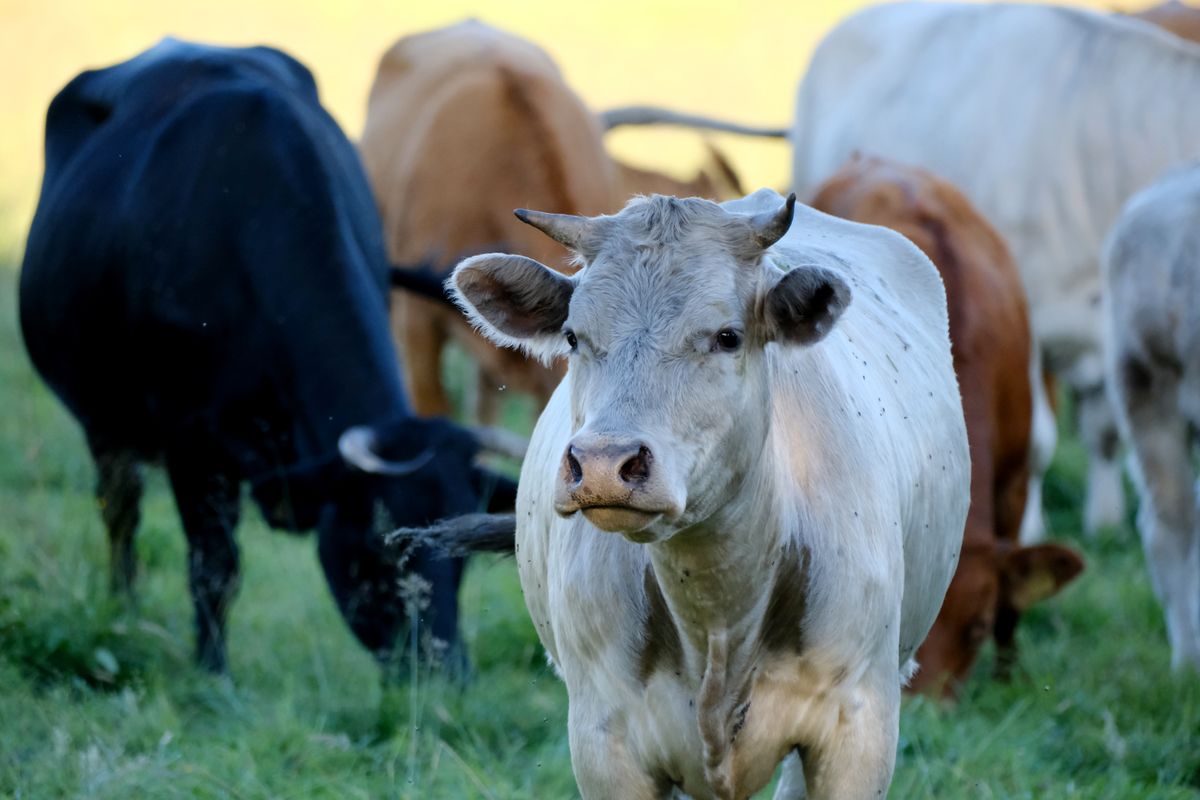
Photo by Roman Biernacki via Pexels
How many cows would the planet actually need if every meat-eater "bought local"? More than the planet has room for, and more than the climate can survive. That's the short answer.
I milked dairy cows by hand at a biodynamic farm in Sussex, England. Highest welfare standards on Earth. Picture the Instagram fantasy — wooden fences, cows with names, a farmer who reads philosophy while he forks hay. I watched them slaughter cattle there too. The cow doesn't care that the field she lived in was beautiful. She cares that you're killing her.
I'm telling you this because every time I write something about meat, somebody slides into the comments with the same line: "But I only buy from a local farm. From a small operation. From a regenerative producer." As if geography is a moral force field. As if the cow's death is offset by the farmer's authenticity.
So let's actually do the math on the local farm argument. Five minutes. That's all it takes to fall apart.
The Land Math Is Genocidal — Pick a Different Word If You Want But It Stays
Right now, beef cattle use roughly 60% of the world's agricultural land while delivering less than 2% of global calories and around 5% of global protein. That's the baseline. That's industrial beef — feedlots, soy and corn shipped in, animals confined for the final months. The land cost is already insane.
Now imagine your "buy local, buy grass-fed" world. Take cattle off feed and put them on pasture. They grow slower. They produce less meat per animal. Per kilogram of beef, you need more land, more time, more cows.
How much more? A 2018 study by Hayek and Garrett at Harvard ran the numbers for the United States alone. Going 100% grass-fed at current beef demand would require an extra 200,000 square miles of pasture — bigger than New York, Pennsylvania, Florida, and Ohio combined. A different Harvard analysis found that pure pasture systems would need 30% more cattle to produce the same beef.
That's the United States. One country. Now scale that demand structure to 8 billion humans. Where does the extra land come from? The Food and Agriculture Organization already tracks about a quarter of the planet's total land surface as grazing land. There's no second Earth lying around for the rest.
So when somebody says "we should all eat meat from small local farms," what they're actually saying is: "I'd like to triple the land footprint of an industry that's already eating the planet. And I'd like the bottom 80% of humans to keep eating beans while I do it." Cool plan.
Grass-Fed Beef Has More Methane, Not Less
Now the part that breaks people's brains. The marketing for grass-fed beef sells you a climate-friendly steak. You picture the cow chewing native prairie grass, sequestering carbon, healing the soil. The carbon-neutral burger.
The math says no. Per kilogram of beef, grass-fed cattle emit more methane than feedlot cattle, not less. A March 2025 paper in PNAS by Eshel and colleagues — peer-reviewed, hard to wave away — concluded that US grass-fed beef is as carbon intensive as industrial beef and roughly 10 times more carbon intensive than common protein-dense alternatives. The Harvard work I cited earlier estimated grass-fed methane emissions 43% higher than the conventional system at scale.
Why? Two reasons. First, grass is harder for ruminants to digest than corn — more cellulose and lignin, more enteric fermentation, more methane belched out per pound of beef produced. Second, grass-fed cattle live longer before slaughter. Eighteen to thirty months instead of fourteen. Did the marketing brochure mention that the longer life is part of the climate problem? Of course it didn't. Eighteen to thirty months of methane emissions per cow, distributed across a smaller carcass.
Allan Savory, the patron saint of "holistic grazing," gave a TED talk in 2013 claiming we could reverse climate change by putting more cattle on more grasslands. The Food and Climate Research Network spent two years and reviewed over 300 studies in their 2017 "Grazed and Confused" report. Their conclusion: even under the most generous assumptions, soil carbon sequestration from grazing offsets only 20% to 60% of livestock's own emissions. Net positive climate impact? Not happening. Even the soil-sequestration story has its own ceiling — over a few decades soil saturates and stops absorbing additional carbon.
The "regenerative grazing" movement keeps quoting Savory because his slogan is good for selling steak. The peer-reviewed literature — Poore and Nemecek 2018 in Science, the FCRN team, Eshel's PNAS paper, the Oxford Nature Food group — keeps saying the same thing in different words. There is no version of beef that scales.
"Local" Is the Weakest Variable in the Whole Equation
Here's the part that should make every locavore close their laptop and reconsider their personality.
The classic study on this is Weber and Matthews 2008 in Environmental Science & Technology. They ran life-cycle analysis on the average American household's food carbon footprint and found that transportation accounts for roughly 11% of food-related emissions. The final delivery from producer to retail — the "food miles" you've been obsessing about — is just 4%. Production accounts for 83%.
Then they ran the gut-punch number: shifting less than one day per week's worth of calories away from red meat and dairy toward chicken, fish, eggs, or plants reduces more emissions than buying every single calorie locally. That's not a vegan op-ed. That's Carnegie Mellon engineering. The locavore credential card you've been carrying is worth less than skipping beef on Mondays.
Eat a beef burger sourced from a farm you can see from your kitchen window. Now eat a tofu wrap shipped 3,000 miles. The tofu still wins. By a lot. Because production emissions dwarf transport emissions, and beef production emissions dwarf everything.
The "Grass-Fed" Label Is Almost Meaningless in the US
Let me drop one more inconvenient fact. In January 2016, the USDA's Agricultural Marketing Service revoked the federal grass-fed labeling standard. They concluded they didn't have legal authority to enforce it. Producers can now self-define what "grass-fed" means.
That means the $22-per-pound strip steak in your local butcher's case might come from cattle that ate grass for 90 days and corn for the rest of their lives. Or that lived in confinement for the finishing period. Or that came from a multi-state meatpacker laundering ground beef under a small farm's logo. The Food Safety and Inspection Service approves the label based only on a feeding protocol the producer writes themselves. Confinement, antibiotics, hormones — all left to the rancher's preference.
The third-party certifications (American Grassfed Association, PCO Certified Grassfed, Animal Welfare Approved) tighten the rules, but those represent a tiny share of the market. The "grass-fed" sticker on a Whole Foods package, in most cases, is an aesthetic choice rather than a regulatory category. You're paying a 48% to 193% premium — current 2025 USDA grass-fed beef reports show grass-fed strip steak ranging from $16.88 to $22.38 per pound versus around $14 conventional — for a category that's enforced on the honor system.
The Small Farmer Doesn't Need You. The Animal Does.
I lived this. Two years at Emerson College in Sussex doing biodynamic agriculture. A year on my own donkey farm outside Athens, milking, naming, learning the personality of every animal I worked with. The romanticism is real. I'm not going to pretend the small-farm aesthetic is a marketing trick — those farms exist, those farmers care, and the animals there have lives that resemble lives.
And I'll tell you what I noticed. The cow's friend goes to the truck and doesn't come back, and the cow knows. The dairy cow who was just impregnated for the seventh time looks at you with the same eyes she had after the second one. The "humane" slaughter floor is calmer than a factory line, sure — but the ending is identical. A bolt gun, a knife, a body. There is no nice way to kill someone who doesn't want to die.
The small-farm argument confuses welfare with ethics. They're not the same. A two-year-old cow living on rotational pasture is treated better than a feedlot cow. That's true. The two-year-old cow still ends up in a body bag at age two when her natural lifespan is twenty. Better treatment doesn't redeem the killing — it just delays it under nicer conditions. You wouldn't accept that calculus for your dog. You wouldn't accept it for your neighbor's dog. You accept it for cows because the marketing told you they're food.
What the Argument Actually Is
I've been on both sides of this conversation. I know what you're really doing. You're not trying to convince me of anything — you're trying to convince yourself. The "local farm" frame is a cognitive escape hatch. It lets you keep the meals you grew up with and outsource the moral discomfort to a romantic narrative about a farmer you've never met.
And I get it. Going vegan in your forties — like I did, in 2019, after a decade of farming, donkey-milking, vegetarian-at-home-meat-at-restaurants confusion — is not painless. The food culture, the family table, the easy weeknight meal. None of that surrenders gracefully. So you reach for the label that lets you keep the beef and keep the conscience.
It just doesn't survive scrutiny. Let me put the entire local-farm argument in its actual form:
- Land math: impossible at scale; current pasture is already 60% of farmland
- Climate math: grass-fed emits more methane per kilo, not less; carbon offset claims fail peer review
- Local math: transport is 4% of food emissions; what you eat matters 20× more than where it came from
- Label math: "grass-fed" is unregulated in the US; you're paying a 48–193% premium for a self-policed claim
- Ethics math: better welfare ≠ no harm; the animal still dies, just in a prettier field
The argument doesn't fail because vegans are mean. It fails because the numbers don't work, the climate doesn't care about your zip code, and the cow doesn't care about your farmer's beard.
What to Do With This
So what now? The next time someone hits you with "but I buy local," don't get into a fight. Share this post with them. Or send them the soy/Amazon math. Or the carbon-credits scam. Or the $38 billion subsidy paper. The data does the work that arguments can't.
And if you're the one making the argument — pause. Sit with it. The fact that you're reaching for "but local" means you already know factory meat is indefensible. You're 80% of the way to the answer. The remaining 20% is the part where you stop bargaining with yourself. You need to be honest about what the calculus is actually saying.
So here's the action item. Go vegan for a week. Seven days. No animal products. You should stop buying the romantic story too — try the math instead. If the math holds at the end of those seven days — and it will — keep going. Time to make the change.
References
- Eshel, G., Stainier, P., Heard, B., et al. (2025). "US grass-fed beef is as carbon intensive as industrial beef and ≈10-fold more intensive than common protein-dense alternatives." PNAS.
- Hayek, M. N., & Garrett, R. D. (2018). "Nationwide shift to grass-fed beef requires increase in cattle inventory." Harvard / Environmental Research Letters.
- Garnett, T. et al. (2017). "Grazed and Confused?" Food and Climate Research Network, University of Oxford.
- Poore, J., & Nemecek, T. (2018). "Reducing food's environmental impacts through producers and consumers." Science, 360(6392).
- Weber, C. L., & Matthews, H. S. (2008). "Food-miles and the relative climate impacts of food choices in the United States." Environmental Science & Technology.
- National Sustainable Agriculture Coalition (2016). "USDA Revokes Grass Fed Label Standard."
- USDA Agricultural Marketing Service (2025). "National Grass Fed Beef Report."
- FAO (2003). "World Agriculture: Towards 2015/2030 — An FAO Perspective."
- Hawkins, T. (2019). "Is Grass-Fed Beef Really Better For The Planet? Here's The Science." NPR.