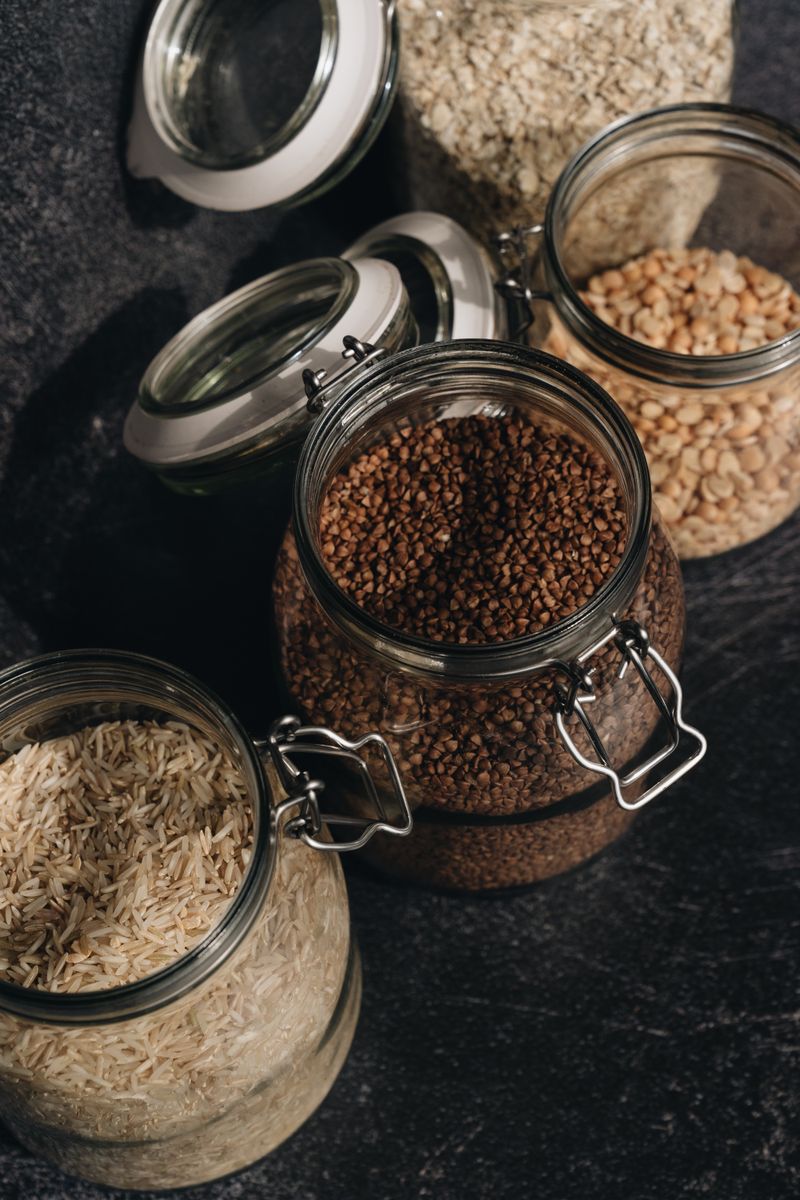
Ground beef hit $6.69 a pound in December 2025. That's up 19.3% from the year before. And the USDA Economic Research Service is projecting another 10% increase in 2026 -- because the U.S. cattle herd just fell to its lowest point since 1951. Eighty-six million head, down from 95 million in 2019. When a herd shrinks like that, it takes years to rebuild. You breed, you wait for calves, you wait for the calves to grow. The cheap meat era isn't having a rough patch. It's structurally, mathematically over.
I did my grocery run last week. Seven days of food. $23.47 total.
Still think veganism is expensive?
The Grocery Run: $23.47
One trip. Walmart. Because this experiment isn't about proving a point at Whole Foods -- it's about proving a point about reality.
- Dry black beans, 2 lbs -- $1.78
- Dry brown rice, 5 lbs -- $3.24
- Dry lentils (green), 1 lb -- $1.28
- Oats (store brand), 42 oz -- $2.98
- Frozen mixed vegetables, 2 bags -- $2.50
- Bananas, 3 lbs -- $1.47
- Onions, 3 lb bag -- $1.98
- Garlic, 3 heads -- $1.00
- Canned diced tomatoes, 3 cans -- $2.37
- Peanut butter (store brand), 16 oz -- $1.88
- Whole wheat bread -- $1.28
- Frozen spinach, 1 bag -- $1.00
- Soy sauce -- $0.98
Total: $23.47 after tax. That's $3.35 per day. Under a dollar per meal.
For context: the USDA's Thrifty Food Plan -- the government's official floor estimate for minimum adequate nutrition -- puts a single adult at $57-71 per week as of January 2025. That's the cheapest the government thinks anyone can realistically eat, on any diet. I came in at less than half that.
What I Actually Ate
Monday: Oatmeal with banana and peanut butter. Black bean and rice bowl with sauteed onion, garlic, cumin, canned tomatoes. Lentil soup with frozen spinach.
Tuesday: Peanut butter toast with banana. Leftover lentil soup -- I always make a massive batch. Fried rice with frozen veggies and soy sauce.
Wednesday: Oatmeal. Rice and beans with hot sauce. Black bean tacos using bread as wraps. Don't judge. It worked, and I wasn't buying tortillas when bread was already in the cart.
Thursday: Oatmeal with peanut butter stirred in. Lentil and rice bowl with frozen vegetables. Bean chili -- black beans, lentils, tomatoes, onion, cumin, chili powder -- enough for two days.
Friday: Peanut butter banana toast. Leftover chili over rice. Garlic fried rice with spinach.
Saturday: Big bowl of oatmeal. Rice and beans, last of the tomatoes. Lentil stew with onions and mixed vegetables.
Sunday: Peanut butter oatmeal. Leftover lentil stew. Bean and rice bowls with whatever was left in the pot.
Was it monotonous? Some days. Was it nutritionally complete, filling, and under a dollar per meal? Every single day.
The Nutrition Question (Yes, Including Protein)
Let me get ahead of this.
A cup of cooked lentils has 18 grams of protein. A cup of black beans has 15 grams. Add rice, oats, and peanut butter across the day, and I was hitting 60-70 grams of protein without tracking anything. That exceeds the RDA for a sedentary adult. And I wasn't even trying.
Here's a number that should end this conversation permanently: in 2024, the Vegetarian Resource Group published actual price-per-gram-of-protein comparisons. Dried pinto beans delivered protein at $0.12-0.14 per 10 grams. Ground beef: $0.50-0.52 per 10 grams. Bean protein costs one-fourth what beef protein costs. That data was collected before beef spiked another 19% in late 2025.
The whole "you can't get enough protein from plants" argument -- the science hasn't supported it in decades. The Academy of Nutrition and Dietetics confirmed in their official position paper that well-planned plant-based diets meet all nutritional needs. This isn't fringe nutrition. It's the professional consensus.
Iron? Lentils have 3.3mg per 100g cooked -- about 18% of daily value. Frozen spinach adds more. Pair with vitamin C (the canned tomatoes I bought) and absorption increases significantly.
One thing I won't dodge: B12. Plants don't produce it. The NIH is clear -- vegans are a risk group for deficiency. The fix takes 30 seconds: two tablespoons of nutritional yeast covers your daily 2.4 micrograms, or a B12 supplement runs under $5 for 200 tablets. Budget $0.50 a week and the gap closes completely. I didn't include it in the $23.47 because I already had it. Account for it and you're still under $25.
The Inflation Argument Nobody Is Making
I want to make a different case than the one you usually hear about budget veganism.
The U.S. cattle herd reached 86.7 million head in 2024 -- the lowest since 1951. Drought, high feed costs, and producers selling off breeding stock during inflationary pressure all contributed to the collapse. Rebuilding takes years. You can't flip a switch. CNBC's December 2025 analysis called it "hard to fix" because of the time lag. Supply will stay constrained. Prices will keep climbing.
Meanwhile: dried beans haven't done that. Rice hasn't done that. Lentils cost roughly what they cost a decade ago. Grains and legumes don't depend on breeding cycles, imported feed, or herd recovery timelines. Their prices fluctuate -- they don't spike 20% in twelve months due to structural supply collapse.
And then there's this. USDA data released in December 2025 showed that 13.7% of U.S. households -- 18.3 million families -- were food insecure at some point in 2024. Among households below the federal poverty line, that number hits 39.4%. Among households with children: 18.4%.
The people most exposed to food insecurity are being hit hardest by meat price inflation. And the foods that offer the most nutrition per dollar -- the rice, beans, lentils, and oats I bought for $23.47 -- are vegan by default. These are the foods that carried civilizations through every famine and economic collapse in human history. They're cheap because they're efficient. Run a field of soybeans through a cow first, and you lose roughly 90% of the calories before the food reaches a human plate. Skip the cow, and you feed ten times as many people from the same land.
What a JAMA-Published Trial Found
A November 2024 study in JAMA Network Open -- not a wellness blog, not a vegan advocacy group, the Journal of the American Medical Association -- followed participants through a randomized controlled trial comparing a low-fat vegan diet against standard eating. The vegan group's food costs dropped 19% compared to the standard American diet. That's roughly $657 in annual savings. The reduction on meat alone: $2.90 per day. Harvard Health covered it in February 2025.
A 2021 Oxford modeling study in The Lancet Planetary Health found vegan diets reduce food costs by up to one-third in high-income countries. Multiple independent studies. Multiple methodologies. Same direction every time.
Plant-based eating is cheaper, not despite the evidence, but because of it.
Yes, It Got Boring. Here's the Fix.
Day 5 of lentil soup iterations is not the highlight of anyone's week. I won't pretend otherwise. This was a floor experiment -- the absolute minimum viable vegan week, proven to be nutritionally complete and under a dollar per meal.
For $5-10 more, it transforms:
- Tofu ($1.50-2.00) -- absorbs any flavor, completely different texture from beans
- Sweet potatoes ($2 for 3 lbs) -- roasted, mashed, or thrown in soup, the meal changes entirely
- Seasonal produce ($2-3) -- whatever's cheap at the produce section that week
- Curry powder, turmeric, paprika ($1-2 each) -- the same beans become five different cuisines
At $30-35 per week you're eating better than most Americans eat at any budget -- more micronutrients, more fiber, more variety than the Thrifty Food Plan even accounts for. The monotony argument dissolves when you treat the $25 week as a baseline, not a ceiling.
Why the Myth Won't Die
Because when people hear "vegan food," they picture the wrong price tier.
Beyond Burgers at $8 for two patties. Cashew brie at $14. Oat milk lattes at $7. Cold-pressed juice at $11. "Activated" snack bars for $3.50 each. This is the luxury tier of plant-based eating -- it exists, it's real, and it's completely irrelevant to the $23.47 experiment.
Nobody says "driving is expensive" because Lamborghinis exist. Nobody says housing is unaffordable because Manhattan penthouses exist. But say "vegan food" and suddenly everyone's pricing out the artisan refrigerated section.
The staple foods of a plant-based diet -- rice, beans, lentils, oats, potatoes, frozen vegetables, bananas, peanut butter -- are the cheapest foods at every grocery store in America. This isn't an accident. They're cheap because they're calorie-dense, shelf-stable, and don't require running thousands of pounds of grain through an animal first.
And the same media machine that carries meat industry advertising would prefer you keep comparing Beyond Burgers to ground beef instead of comparing dried beans to ground beef. Confusion is profitable. Keep people in the wrong comparison, and they stay right where they are -- buying what makes the industry money.
Your Shopping List
One week. Under $25. Same list I used:
- Dry beans (any kind) -- 2 lbs
- Rice -- 5 lbs
- Lentils -- 1 lb
- Oats -- large container
- Frozen vegetables -- 2 bags
- Bananas
- Onions
- Garlic
- Canned tomatoes -- 3 cans
- Peanut butter
- Bread
- Frozen spinach
- Soy sauce
Cook beans and rice in bulk on Sunday. Everything else is 15-20 minutes of active cooking, most of it while the batch cooks itself. You'll spend less time in the kitchen than you spend on Instagram.
At the end of seven days, you'll have spent less than what most people spend on two work lunches -- while eating food that required no factory farms, no antibiotics, no overcrowded feedlots, and no 1,800 gallons of water per pound to produce.
The math works. The nutrition works. The only thing that doesn't work is the story you've been told about why it won't.
$23.47. Seven days. Full nutrition. Zero animals harmed. Your move.
References
- Kahleova, H. et al. (2024). "Food Costs of a Low-Fat Vegan Diet vs a Mediterranean Diet." JAMA Network Open. PMC11574688
- Harvard Health Publishing (February 2025). "Going vegan may help your wallet as well as your heart." Harvard Health
- USDA Food and Nutrition Service (January 2025). Cost of Food -- Thrifty Food Plan. USDA FNS
- Vegetarian Resource Group (2024). "The Cost of Beans vs. Meat." VRG Journal
- USDA Economic Research Service (2025). Food Price Outlook -- Summary Findings. USDA ERS
- USDA Economic Research Service (December 2025). Household Food Security in the United States in 2024. USDA ERS
- NIH Office of Dietary Supplements. Vitamin B12 -- Health Professional Fact Sheet. NIH ODS
- Mangels, A.R. et al. (2016). "Position of the Academy of Nutrition and Dietetics: Vegetarian Diets." Journal of the Academy of Nutrition and Dietetics. PubMed
- CNBC (December 2025). "Beef prices are soaring. Here's why that's hard to fix." CNBC